

Key Takeaways
- LASIK candidacy depends on more than your glasses or contact lens prescription.
- Eye doctors evaluate corneal thickness, corneal shape, tear film health, prescription stability, and overall eye health before recommending surgery.
- Dry eye, thin corneas, irregular corneal mapping, unstable vision, and certain health conditions may delay or rule out LASIK.
- Patients who are not ideal LASIK candidates may still qualify for alternatives such as PRK, SMILE, implantable contact lenses, or refractive lens exchange.
- A laser eye surgery consultation helps you understand your options, risks, recovery expectations, and whether LASIK is a safe fit for your eyes.
Choosing LASIK can feel exciting, but it can also bring up a very real question many patients don’t consider: what if your eyes are not the right fit? That uncertainty is exactly why a laser eye surgery consultation matters. LASIK candidacy is not based on one prescription number or how tired you are of glasses. It depends on how your eyes focus, heal, lubricate, and respond to detailed measurements.
At St. Clair Eye Clinic, we help you understand whether LASIK is appropriate for your eyes, your lifestyle, and your long-term vision needs before you take the next step.
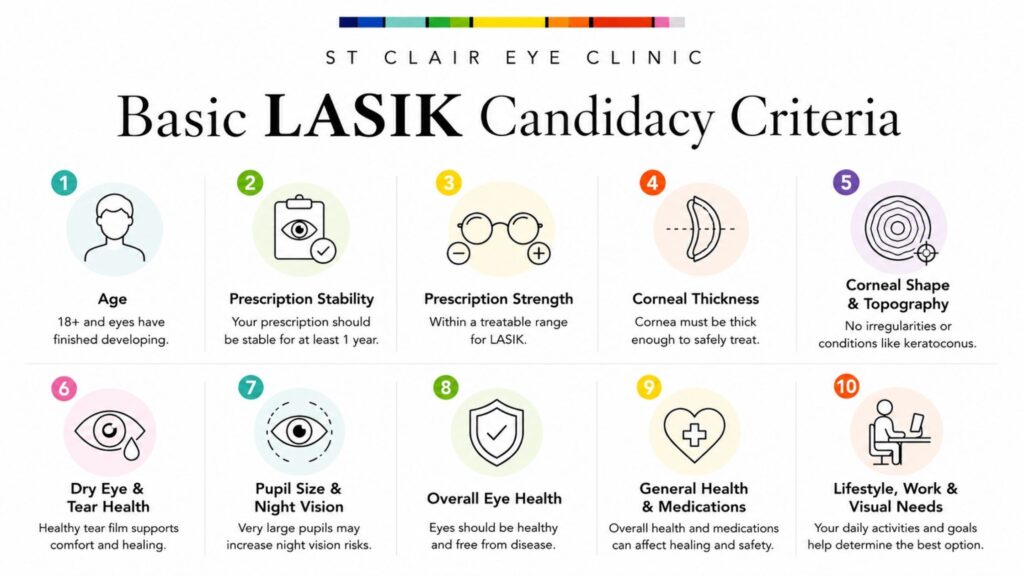
Basic LASIK Candidacy Criteria
1. Age
LASIK is generally considered for adults whose eyes have finished developing. Most laser vision correction candidates are at least 18, but many eye doctors prefer to see patients in their early 20s or older because prescriptions are more likely to have stabilized by then.
Age also matters because your near vision changes over time. If you are in your 40s or older, you may be developing presbyopia, which affects reading and close-up focus. LASIK can still be an option for some people, but your doctor will discuss whether you may still need reading glasses afterward.
2. Prescription Stability
If your glasses or contact lens prescription has changed significantly within the last year, surgery may be delayed until your vision settles.
LASIK reshapes the cornea based on your current prescription. If that prescription is still shifting, the correction may not remain accurate. This is especially common in younger adults, people with fluctuating blood sugar, and people experiencing hormonal changes.
Your eye doctor will review your prescription history to determine whether your vision has been consistent enough for surgery to make sense.
3. Prescription Strength
LASIK can correct many cases of nearsightedness, farsightedness, and astigmatism, but every prescription has limits. Very high prescriptions may require too much corneal reshaping, increasing the risk of poor stability or less predictable results.
This doesn’t automatically mean you’re out of options. Your doctor needs to assess whether LASIK is the safest and most effective approach for your prescription. Some patients with higher prescriptions may be better suited to another refractive procedure, such as PRK, SMILE, implantable contact lenses, or refractive lens exchange. More on this below.
4. Corneal Thickness
LASIK works by reshaping corneal tissue, so your cornea must be thick enough to support the procedure. During LASIK, a flap is created and the underlying corneal tissue is treated with a laser. Your surgeon must leave enough healthy tissue behind for the cornea to remain strong.
If your cornea is too thin, LASIK may increase the risk of corneal weakening or distortion over time. A thin cornea does not always rule out vision correction, but it may make another procedure safer.
5. Corneal Shape and Topography
Thickness is only part of the corneal assessment. Your eye doctor also evaluates the shape and curvature of your cornea using specialized mapping technology. This helps detect irregularities that may not be obvious during a standard eye exam.
One of the most important conditions doctors screen for is keratoconus, a progressive thinning and bulging of the cornea. LASIK is generally not recommended when the cornea shows signs of instability, even if your prescription seems treatable.
6. Dry Eye and Tear Film Health
Dry eye is a major LASIK consideration because the procedure can temporarily worsen dryness, irritation, burning, and fluctuating vision. If your tear film is already unstable, your doctor may recommend treating dry eye before moving forward.
This is especially important if you wear contact lenses, spend long hours on screens, have meibomian gland dysfunction, or experience gritty, tired, watery eyes. Watery eyes can still be a dry eye symptom when your tears evaporate too quickly.
A healthy ocular surface supports clearer measurements, better healing, and a more comfortable recovery after laser vision correction.
7. Pupil Size and Night Vision
Your pupils naturally enlarge in dim light, but very large pupils may increase the risk of night vision symptoms after LASIK, including halos, glare, starbursts, or reduced contrast. These symptoms can be especially noticeable while driving at night.
During your consultation, your eye doctor may evaluate pupil size under low-light conditions and compare it with your prescription, corneal measurements, and treatment zone.
8. Overall Eye Health
Good LASIK candidates need healthy eyes beyond their glasses prescription. Eye doctors look for conditions that could interfere with healing, increase inflammation, or affect visual results. This includes glaucoma, cataracts, retinal disease, corneal scarring, eye infections, uveitis, and previous eye injuries or surgeries.
Some of these conditions do not cause obvious symptoms at first, which is why a comprehensive eye exam is so important. LASIK corrects refractive error, but it doesn’t treat eye disease. If another eye health concern is present, your doctor may recommend managing that condition first or choosing a different vision correction strategy.
9. General Health and Medications
Your body’s ability to heal matters after LASIK. Certain medical conditions, immune system disorders, poorly controlled diabetes, and medications that affect healing may increase surgical risk. Eye doctors also ask about steroid use, immunosuppressant medication, skin medications, and other prescriptions that may affect the eyes or recovery.
Pregnancy and breastfeeding can also temporarily change your prescription and tear film, so LASIK is usually postponed until your vision is stable again.
10. Lifestyle, Work, and Visual Needs
LASIK candidacy also depends on how you use your eyes every day. Someone who works on screens all day, drives frequently at night, plays contact sports, works in dusty environments, or has a profession with specific visual standards may need a more detailed discussion.
For example, jobs in aviation, policing, firefighting, or the military may have specific requirements around refractive surgery. People involved in martial arts or other high-impact activities may need to consider flap-related risk. Your doctor will also ask what you expect from surgery, because the best procedure is the one that fits your real life.
Contraindications and Disqualifying Factors
LASIK may not be recommended if you have an unstable prescription, thin or irregular corneas, untreated severe dry eye, keratoconus, active eye inflammation, significant cataracts, uncontrolled glaucoma, or certain retinal conditions. Some systemic health concerns can also make surgery less appropriate, especially if they affect healing or increase infection risk.
Pregnancy, breastfeeding, and some medications may temporarily disqualify you because they can change vision or tear quality. In some cases, your doctor may say “not right now,” because it’s best to treat, monitor, or stabilize something before reconsidering surgery.
Alternative Vision Correction Options
If LASIK is not the right fit, you may still have excellent options. PRK can be a better choice for some people with thinner corneas because it does not involve creating a corneal flap. SMILE may be considered for some nearsighted patients with astigmatism. Implantable contact lenses may suit people with higher prescriptions who are not ideal candidates for corneal laser surgery.
For some adults, especially those approaching cataract age or dealing with presbyopia, refractive lens exchange may be discussed. A consultation is crucial for identifying if LASIK is best, or whether another option offers a safer path to clearer vision.

Expectations and Potential Risks
LASIK can reduce dependence on glasses or contact lenses, but it doesn’t guarantee perfect vision in every setting. Some patients still need glasses for night driving, detailed work, or reading later in life. Dryness, glare, halos, light sensitivity, undercorrection, overcorrection, and fluctuating vision can occur, especially during healing. Serious complications are uncommon but possible.
Choosing a Surgeon and Technology
The right surgeon should be experienced, transparent, and willing to explain why a specific procedure is recommended for your eyes. Technology matters, but it should never take precedence over careful clinical judgment.
It is also worth asking who will manage your pre-surgical and post-surgical care. At St. Clair, we help our patients understand their candidacy, review their eye health, and help them make informed decisions before referring them for surgery when appropriate.
Pre- and Post-Surgery Guidelines
Before LASIK, you may need to stop wearing contact lenses for a period of time because contacts can temporarily change the shape of your cornea and affect surgical measurements. Your doctor may also ask you to avoid eye makeup before surgery, arrange transportation, and carefully follow preparation instructions.
After surgery, you will need to use prescribed drops, avoid rubbing your eyes, protect your eyes as directed, and attend follow-up appointments. These guidelines are essential to support healing, reduce complications, and give your eyes the best chance of regaining stability.
In Short…
LASIK decisions should never be made hastily, without a complete understanding of your eyes, your health, and the visual demands of your daily life.
If you’re wondering whether LASIK is right for you, book a laser eye surgery consultation today. We’ll evaluate your candidacy, answer your questions, and help you make an informed, confident decision.
Frequently Asked Questions About LASIK Eligibility
How do I know if I am a good candidate for LASIK?
You may be a good LASIK candidate if you are an adult with a stable prescription, healthy eyes, adequate corneal thickness, and realistic expectations. Your eye doctor will also assess dry eye, corneal shape, pupil size, medical history, and lifestyle needs before recommending laser eye surgery.
What can disqualify someone from LASIK?
LASIK may not be recommended if you have thin or irregular corneas, unstable vision, untreated severe dry eye, keratoconus, active eye inflammation, advanced glaucoma, significant cataracts, or certain health conditions that affect healing. Pregnancy, breastfeeding, and some medications may also delay LASIK candidacy.
Can I get LASIK if I have dry eyes?
You may still qualify for LASIK if your dry eye is mild and well-managed, but untreated dry eye can affect measurements, comfort, and healing. During a LASIK consultation, your eye doctor can evaluate your tear film and recommend treatment before deciding whether surgery is appropriate.
What are my options if I am not a LASIK candidate?
If LASIK is not the right fit, your eye doctor may discuss alternatives such as PRK, SMILE, implantable contact lenses, or refractive lens exchange. The best option depends on your prescription, corneal thickness, age, eye health, and visual goals.
Where can I book a LASIK consultation in Midtown Toronto?
You can book a laser eye surgery consultation in Midtown Toronto at St. Clair Eye Clinic to find out whether LASIK is right for your eyes. We assess your prescription, corneal health, dry eye risk, eye health history, and expectations so you can make an informed decision.