

Key Takeaways:
- A cataract forms when proteins within the eye’s natural lens break down and create cloudy areas that interfere with how light is focused.
- Nuclear, cortical, posterior subcapsular, and congenital cataracts can affect different parts of the lens and produce different visual difficulties.
- Common symptoms include hazy vision, faded colours, glare, halos, poor night vision, and frequent changes to your prescription.
- Aging is the leading risk factor, while diabetes, smoking, UV exposure, corticosteroid use, eye injuries, and family history can increase your likelihood.
- UV protection, smoking cessation, diabetes management, protective eyewear, and regular eye exams may help reduce avoidable risks.
- A comprehensive eye exam determines whether a cataract is causing your symptoms and checks for other conditions that could affect treatment.
- Early cataracts may be managed with updated glasses and better lighting, while surgery replaces a functionally limiting cataract with an artificial lens.
Few eye conditions literally change the way the world looks as a cataract does. As the eye’s natural lens becomes cloudy, colours can lose their richness, headlights may flare, and familiar details may appear washed out or hazy. That shift can be frustrating, especially when glasses no longer restore the crisp vision you expect. Cataracts are highly manageable, and the right assessment can bring clarity to both your eyesight and the decisions ahead.
Understanding What Changes Inside the Eye During Cataracts
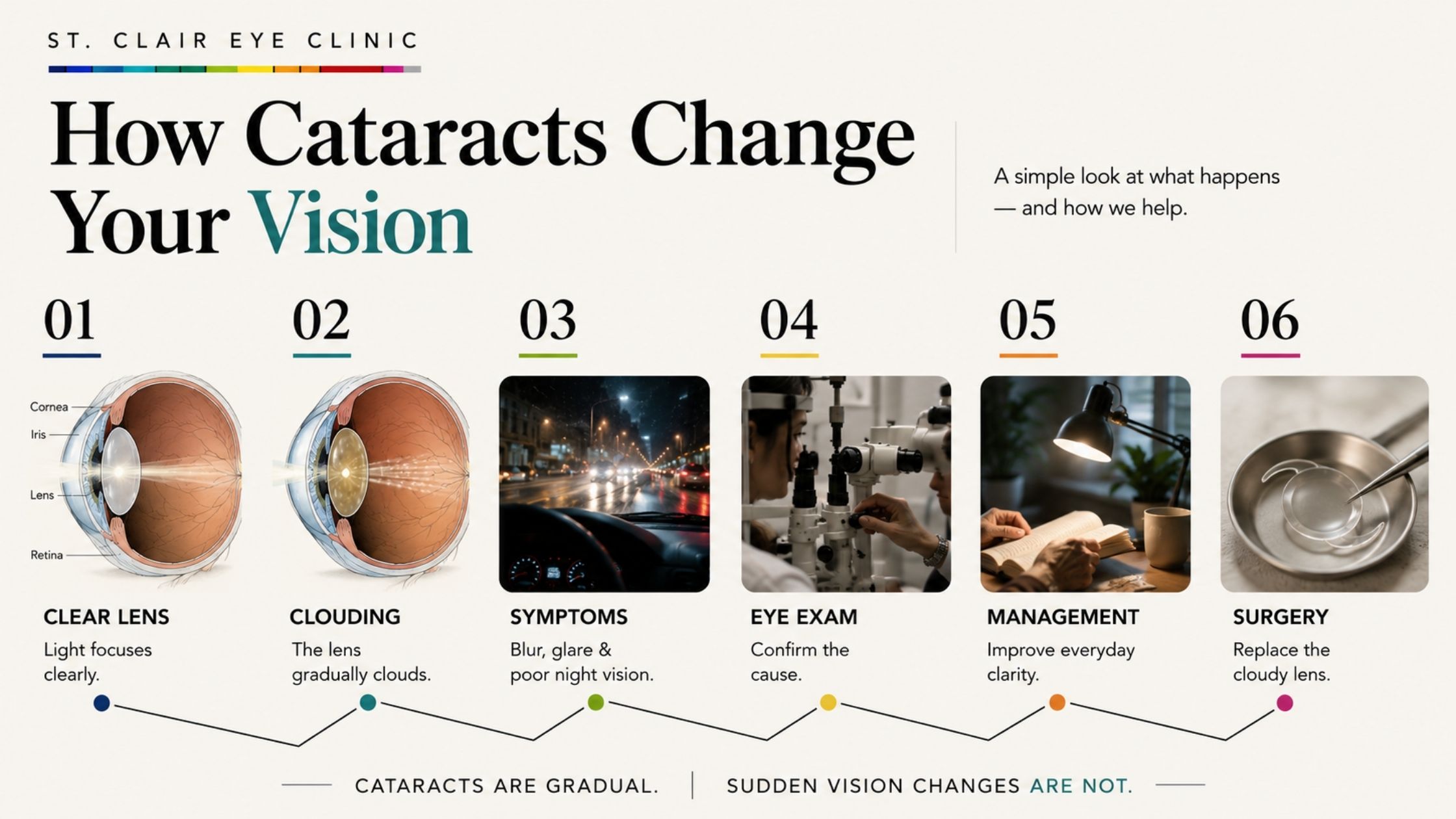
Behind the coloured iris sits the eye’s natural lens. It bends incoming light so it lands on the retina, where light is converted into signals for the brain. A healthy lens is transparent.
As the lens ages, its proteins can break down and clump together. It may also become less flexible and take on a yellow or brown tint. These changes create cloudy areas that scatter or block light instead of focusing it cleanly. That clouding is a cataract.
Cataracts can form in one eye or both, although each eye may progress differently. They do not spread between eyes. The change occurs inside the lens, which is why blinking or using lubricating drops does not clear it.
Different Cataracts Affect Vision Differently
The location of the clouding helps explain why symptoms vary.
- Nuclear cataracts develop in the centre of the lens and are commonly related to aging. They can cause gradual blur, faded colours, and increased nearsightedness. Some people temporarily find they can read without their usual glasses.
- Cortical cataracts begin near the lens edge and extend inward in spoke-like patterns. Glare and reduced contrast may become noticeable.
- Posterior subcapsular cataracts form near the back of the lens. They may progress more quickly and often make reading, bright light, and nighttime driving difficult.
- Congenital cataracts are present at birth or develop during childhood. Significant clouding can interfere with visual development.
Eye injuries, inflammation, previous surgery, and certain health conditions can also produce cataracts.
Symptoms of Cataracts
Early cataracts might not cause any noticeable symptoms. As the lens becomes cloudier, you may feel as though you are looking through a fogged window. The change is generally painless and gradual.
Common signs include:
- Blurred, hazy, or dim vision
- Colours that appear faded or yellowed
- Greater sensitivity to sunlight, lamps, and headlights
- Halos or starbursts around lights
- Trouble seeing in dim rooms or driving at night
- A need for brighter reading light
- Frequent prescription changes
- Double vision or ghost images in one eye
- Difficulty distinguishing objects from a similarly coloured background
People sometimes adapt without realizing how much clarity they’ve lost. You might stop driving after dark or avoid fine print before connecting those habits to your eyesight.
Cataracts do not typically cause pain, marked redness, flashes, a sudden shower of floaters, or abrupt vision loss. Those symptoms may indicate another problem and deserve prompt assessment.
Causes and Risk Factors
Age is the strongest risk factor. Lens changes often begin in midlife, while cataracts become more common later as protein breakdown and oxidative damage accumulate.
Other factors can contribute to earlier development or faster progression:
- Diabetes. Elevated blood glucose can alter the lens, increasing risk and allowing clouding to develop at a younger age.
- Ultraviolet exposure. Years of UV radiation can damage lens proteins.
- Smoking. Tobacco smoke raises oxidative stress throughout the body, including within the lens.
- Corticosteroid use. Long-term or high-dose steroid treatment can increase risk. Never stop prescribed medication without speaking with the clinician managing it.
- Eye trauma or inflammation. Injury and recurring inflammation can disrupt the lens, sometimes long before a cataract becomes obvious.
- Previous surgery or radiation. Treatment involving the eye, head, or upper body may contribute to cataract formation.
- Family history. Genetics can influence when cataracts appear.
Heavy alcohol consumption and some systemic health conditions are also associated with greater risk. These factors do not make serious vision loss inevitable, but regular monitoring becomes more valuable.
Can Cataracts Be Prevented?
There is no guaranteed way to prevent age-related cataracts. You can, however, reduce avoidable stress on the lens.
Wear sunglasses that provide full UVA and UVB protection. A wide-brimmed hat adds coverage. Use proper safety eyewear for work, sports, and other activities that could injure an eye.
If you smoke, quitting is a meaningful protective step. Managing diabetes with your healthcare team also matters, since steadier blood glucose helps reduce eye-related complications. A varied, nutrient-rich diet supports general health, although no food or supplement can dissolve a cataract.
Routine eye exams remain essential. Screening cannot stop clouding, but it can uncover early changes and distinguish cataracts from glaucoma, macular degeneration, diabetic eye disease, and other conditions requiring different care.
How Cataracts Are Diagnosed
A diagnosis often involves your optometrist asking how your eyesight has changed and which activities have become difficult. Driving, reading, recognizing faces, and navigating stairs all reveal how the cataract affects daily function.
Testing may include:
- Visual acuity measurements at different distances
- Refraction to see whether a new prescription improves clarity
- A slit-lamp examination to view the lens under magnification
- Pupil dilation to assess the lens, retina, and optic nerve
- Glare or contrast testing when an eye chart does not reflect real-world difficulty
- Other tests selected for your eye health and medical history
The exam also determines whether the cataract fully explains your symptoms. The health of the cornea, retina, macula, and optic nerve influences treatment planning and expected results. When clouding is mild, the findings provide a baseline for future comparison.
Treatment and Management
A cataract doesn’t always require immediate surgery. If daily activities remain comfortable, updated glasses, brighter task lighting, anti-glare lenses, or magnification may improve function. Your optometrist can monitor the lens and revisit the plan as your needs change.
No proven eye drop, exercise, or supplement can remove an established cataract. Surgery is the only treatment that replaces the cloudy lens, but timing depends on visual function rather than whether the cataract looks “ripe.”
Deciding When Surgery Makes Sense
Referral to an ophthalmologist becomes reasonable when cataracts interfere with activities that matter to you and glasses no longer help enough. The turning point might be unsafe driving glare, difficulty reading, or less confidence in unfamiliar spaces.
The ophthalmologist will assess your likely benefit. Glaucoma, macular degeneration, corneal disease, or diabetic retinopathy may affect the outcome and sometimes alter the surgical approach.

What Cataract Surgery Involves
Cataract surgery is usually an outpatient procedure. Through a small incision, the surgeon breaks up and removes the cloudy lens, most often using ultrasound in a technique called phacoemulsification. A clear artificial intraocular lens, or IOL, is placed inside the eye to restore focusing power. Local anesthetic is commonly used.
IOL selection is an important part of planning. A monofocal lens usually targets clear vision at one distance, so glasses may still be needed for some tasks. Toric lenses can correct certain levels of astigmatism. Multifocal and extended-depth-of-focus designs may reduce dependence on glasses, but they can produce halos or lower contrast and are unsuitable for some eyes. Your eye health, occupation, visual priorities, and tolerance for these trade-offs should guide the choice.
Recovery and Follow-Up
Vision may look brighter quickly, although temporary blur, mild irritation, or light sensitivity can occur. Prescribed drops help control inflammation and reduce infection risk. You may be told to wear a protective shield, avoid rubbing the eye, and briefly limit water exposure or strenuous activity.
Follow your surgeon’s instructions. Post-operative visits check healing, eye pressure, lens position, and vision. Once the result stabilizes, your optometrist can determine whether updated glasses would improve near or distance vision.
Complications and Prognosis
Without treatment, cataracts usually continue to cloud the lens. Progressive blur can affect daily tasks as discussed earlier, and reduced contrast and depth perception may also contribute to falls and loss of independence.
Cataract surgery has a strong success record, and most patients see better afterward. Improvement depends partly on the rest of the eye. Removing cloudiness can’t reverse vision loss caused by glaucoma, macular degeneration, or diabetic retinopathy.
Complications are uncommon, but no operation is risk-free. Possible problems include infection, inflammation, pressure changes, swelling, retinal tear or detachment, and movement of the IOL. Sudden worsening of vision, increasing pain, significant redness, new flashes, or many new floaters after surgery requires urgent attention.
Months or years later, cells may cloud the capsule holding the IOL. This posterior capsule opacification is not a new cataract. An ophthalmologist can usually clear it with a brief YAG laser procedure.
Know When a Change Deserves a Closer Look
The right time to discuss cataracts is when your vision starts changing how you live, even in small ways. You shouldn’t wait until routine tasks feel unsafe, and a diagnosis doesn’t commit you to surgery. If glare, blur, faded colour, or frequent prescription changes have become familiar, book a comprehensive eye exam at St. Clair Eye Clinic. We can identify the cause, explain your options clearly, and help you plan your next step with confidence.
Frequently Asked Questions About Cataracts
What is a cataract, and how does it develop?
A cataract is clouding within the eye’s natural lens. It develops when proteins in the lens break down and clump together, preventing light from reaching the retina clearly. Most cataracts are related to aging, although diabetes, eye injuries, medications, inflammation, and other factors can contribute.
What are the first signs of cataracts?
Early cataracts may not cause noticeable symptoms. As clouding progresses, you may experience blurry vision, faded colours, greater glare, halos around lights, difficulty driving at night, or a need for brighter reading light. Frequent prescription changes can also indicate that the lens is changing.
Can cataracts be prevented or slowed down?
Age-related cataracts cannot always be prevented. Wearing sunglasses with full UVA and UVB protection, avoiding smoking, managing diabetes, using protective eyewear, and maintaining a nutritious diet may help reduce certain risks. Regular eye exams allow cataracts to be identified and monitored before they significantly affect daily life.
How does an optometrist diagnose cataracts?
An optometrist diagnoses cataracts through a comprehensive eye exam that may include visual acuity testing, refraction, slit-lamp examination, and pupil dilation. These tests reveal where the lens is cloudy, how much vision is affected, and whether another condition such as glaucoma or macular degeneration is contributing to your symptoms.
When should a cataract be removed?
Surgery may be recommended when a cataract interferes with driving, reading, working, recognizing faces, or moving around safely, and an updated prescription no longer provides enough improvement. Cataracts do not need to become “ripe” before treatment. The decision depends on your visual needs, eye health, and expected surgical benefit.
Where can I get checked for cataracts in Midtown Toronto?
You can book a comprehensive eye exam directly with St. Clair Eye Clinic. We’re located at 822 St. Clair Avenue West in Midtown Toronto. Our optometrists can diagnose cataracts, monitor their progression, help manage early symptoms, and arrange an ophthalmology referral when surgical assessment becomes appropriate.