

Key Takeaways
- Common childhood eye conditions include amblyopia, strabismus, binocular vision dysfunctions, conjunctivitis, nystagmus, pediatric cataracts, and refractive errors.
- Amblyopia develops when the brain relies more heavily on one eye, often because of an eye turn, unequal prescriptions, or an obstruction such as a cataract. The affected eye may look completely normal, making a comprehensive eye exam essential for detection.
- Strabismus occurs when the eyes are misaligned, while binocular vision dysfunctions affect how comfortably and accurately the eyes work together. Both can interfere with depth perception, reading, close work, and normal visual development.
- Conjunctivitis can result from viruses, bacteria, allergies, or irritants. Because these causes require different treatments, redness and discharge colour alone should not be used to determine whether a child needs antibiotics.
- Nystagmus causes involuntary eye movements. Children may turn or tilt their heads to find a position where their vision is clearer, which is a helpful adaptation rather than a habit parents should try to correct.
- A white or grey pupil, unusual reflection in photographs, sudden eye turn, severe pain, vision loss, or eye redness with light sensitivity can indicate a serious condition requiring prompt assessment.
- Children may compensate for refractive errors and other vision problems without complaining. Routine comprehensive eye exams can identify concerns that appearance, behaviour, and basic vision screenings may miss.
Kids rarely say, “I can’t see clearly.” They assume everyone sees the way they do, and they often adapt by relying on one eye, sitting closer, or avoiding visually demanding activities. That can make an eye condition easy to mistake for clumsiness, tiredness, or a short attention span. The reassuring part is that many childhood vision problems respond well when they are identified through a children’s eye exam while the eyes and brain are still developing.
Here are the most common eye conditions children experience:
Amblyopia (Lazy Eye)
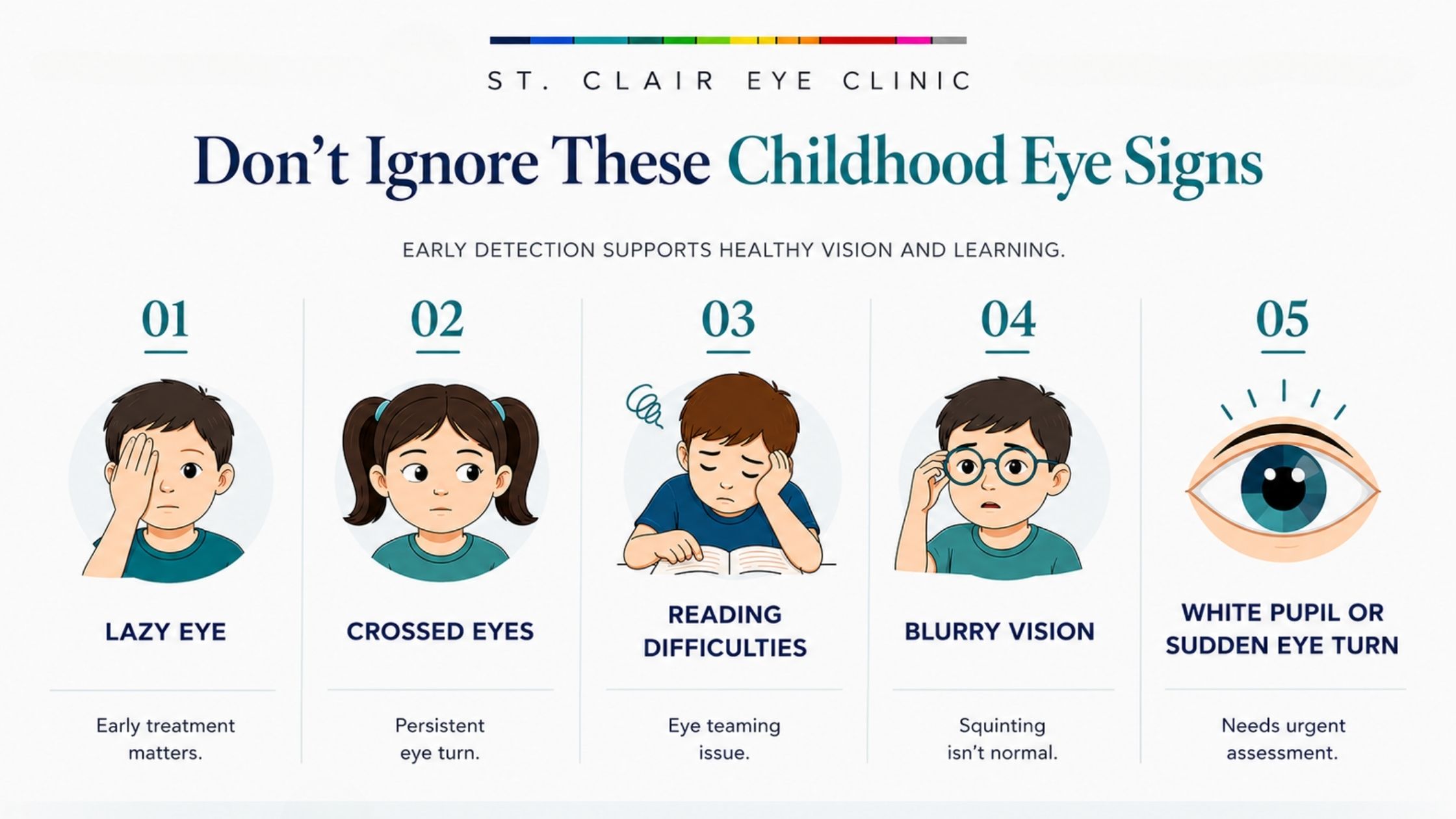
Amblyopia is reduced vision caused by the brain and an eye not developing a strong working connection. It usually affects one eye, although both can be involved. Despite its nickname, the eye is not “lazy,” and it may look completely normal.
The brain begins favouring the clearer image when one eye turns, has a substantially different prescription, or cannot see clearly because of a cataract or another obstruction. A child may squint, close one eye, tilt their head, resist having the stronger eye covered, or have poor depth perception. Frequently, there are no signs a parent can see.
Treatment addresses the cause first. That may mean glasses, followed when necessary by patching the stronger eye or using prescribed atropine drops so the brain uses the weaker eye. Earlier treatment gives the visual system more opportunity to develop properly. Early amblyopia treatment generally works well and can prevent long-term vision problems.
Strabismus (Misaligned or Crossed Eyes)
Strabismus means the eyes don’t point in the same direction. One may turn inward, outward, upward, or downward, either constantly or intermittently. Newborn eye movements can be uncoordinated at times, but a persistent or recurring turn should be checked.
You might notice an eye drifting in pictures, your child closing one eye in bright light, an unusual head turn, or difficulty judging steps and distances. Misalignment can lead the brain to suppress one eye and cause amblyopia.
Treatment depends on the type and cause. Glasses may correct an eye turn related to farsightedness, while some children require prisms, targeted exercises for specific conditions, or eye-muscle surgery. Patching may treat associated amblyopia, but it does not straighten the eyes by itself.
Binocular Vision Dysfunctions
Binocular vision describes how the eyes aim, focus, and combine two images into one. A child can see clearly with each eye separately yet struggle to use them comfortably together. Convergence insufficiency, for example, makes it difficult to keep both eyes directed at close objects.
These problems often become more noticeable when a child starts drawing, looking at books, or doing sustained near work. Watch for your child losing their place, covering one eye, holding material unusually close, rubbing their eyes, headaches, short periods of attention during near tasks, or avoiding puzzles and colouring.
These behaviours have many possible causes, so they can’t be used to diagnose a vision problem on their own. A medical assessment of eye alignment, focusing, tracking, and depth perception can identify the specific issue.
Depending on the findings, care may involve lenses, prisms, prescribed exercises, structured vision therapy, or management of an underlying condition.
Conjunctivitis (Pink Eye)
Conjunctivitis is inflammation of the thin membrane covering the white of the eye and inner eyelids. Viral and bacterial infections, allergies, and irritants can all produce a red or pink eye, but are treated differently. For example, antibiotics do not treat viral or allergic conjunctivitis.
Viral conjunctivitis commonly causes watery discharge and may accompany a cold. Bacterial cases tend to produce thicker discharge and eyelids that stick together. Allergic conjunctivitis usually affects both eyes and causes pronounced itching and watering. Because symptoms overlap, discharge colour alone is not a reliable way to decide on a treatment.
For kids with red or pink eye, encourage handwashing, discourage eye rubbing, and avoid sharing towels. Arrange an assessment for an accurate diagnosis of the cause. Eye pain, light sensitivity, reduced vision, marked swelling, injury, or a red eye in a newborn needs prompt medical attention because these features are not typical of uncomplicated pink eye.
Nystagmus
Nystagmus causes repetitive, involuntary eye movements that may be side to side, up and down, or rotary. It can begin in infancy and may be associated with reduced vision, albinism, cataracts, optic nerve conditions, or neurological disorders.
A child may turn or tilt their head to find a position where the movement lessens and vision is clearer. This is a useful adaptation, not a habit to correct. An eye examination helps determine the pattern, measure vision, and investigate the cause. Nystagmus that begins suddenly, especially with dizziness, imbalance, or other neurological symptoms, requires urgent medical assessment.
Pediatric Cataracts
A cataract is cloudiness in the eye’s natural lens. Some childhood cataracts are present at birth; others develop because of genetics, an eye injury, inflammation, medication, or a medical condition. A small cataract may have little effect, while a dense or centrally located cataract can block the clear image the brain needs for visual development.
Possible signs include a white or grey pupil, an unusual reflection in photographs, poor visual attention, an eye turn, or nystagmus. A vision-limiting cataract in infancy can cause severe amblyopia, so prompt assessment is important.
Treatment depends on its size and effect on vision. Some cataracts are monitored, while others require surgery followed by glasses, a contact lens, or an implanted lens and ongoing amblyopia care.
Refractive Errors
Refractive errors occur when the eye’s shape prevents light from focusing sharply on the retina. Myopia makes distant objects blurry. Hyperopia can make near focusing difficult, although young children may compensate for some farsightedness. Astigmatism causes blur or distortion at multiple distances. Anisometropia means the two eyes have substantially different prescriptions.
A child may sit close to the television, squint, hold books near their face, rub their eyes, complain of headaches, or lose interest in detailed tasks. Yet one eye may quietly compensate for the other, leaving no obvious symptom.
A comprehensive kid’s eye exam measures the prescription without relying entirely on a child’s answers. Glasses usually provide the clear image needed for comfortable vision and normal development. Significant unequal prescriptions also require monitoring for amblyopia. Myopia may progress as a child grows, so regular reviews by our care team at St. Clair Eye Clinic help us determine whether standard correction or myopia-control options should be discussed.
Other Serious Pediatric Eye Conditions
Rare conditions include retinoblastoma, a childhood eye cancer, which may appear as a white pupil in flash photographs, a new eye turn, redness, or swelling. A white pupil should never be assumed to be a camera quirk until an eye care professional has confirmed the cause.
Another is congenital glaucoma, which can cause excessive tearing, light sensitivity, cloudy corneas, or an eye that appears enlarged. Premature infants may need scheduled specialist screening for retinopathy of prematurity. Drooping eyelids, retinal disease, optic nerve abnormalities, inflammation, and serious infections can also interfere with visual development.
Seek urgent care for sudden vision loss, severe pain, chemical exposure, penetrating injury, a fixed or irregular pupil, pronounced swelling with fever, or redness accompanied by light sensitivity. If you see a white pupil or a sudden new eye turn, arrange prompt assessment even if your child seems comfortable.
Early Detection and Eye Exams
Appearance and behaviour alone can’t confirm that your child sees well. A basic screening may detect certain concerns, but it does not replace a comprehensive examination of vision, eye coordination, prescription, and eye health. Child-friendly tests allow us to examine a child’s eyes without expecting them to read letters or explain subtle symptoms.
Ontario optometrists recommend a first exam between six and nine months of age, another around age three, and annual examinations once a child enters school. At the time of this writing, children and youth aged 19 and younger are eligible for one OHIP-insured eye exam every 12 months, but always check the Government of Ontario website for the latest information.
Early eye care gives your child a fair chance to build the visual skills that support movement, confidence, and learning. Book a children’s eye exam if you’ve noticed a concern or your child is due for routine care.
Frequently Asked Questions About Childhood Eye Conditions
What are the most common eye conditions in young children?
Common childhood eye conditions include amblyopia, strabismus, binocular vision dysfunctions, conjunctivitis, nystagmus, pediatric cataracts, and refractive errors such as myopia, hyperopia, and astigmatism. Some cause noticeable changes, while others produce few outward signs and are found only during a comprehensive children’s eye exam.
How can I tell if my child has amblyopia or lazy eye?
A child with amblyopia may squint, close one eye, tilt their head, have poor depth perception, or resist when the stronger eye is covered. However, many children show no obvious symptoms because the stronger eye compensates. An eye exam is needed to compare vision between the eyes and identify the underlying cause.
What is the difference between amblyopia and strabismus?
Amblyopia is reduced vision caused by the brain and one or both eyes not developing a strong visual connection. Strabismus is a physical misalignment in which the eyes point in different directions. Strabismus can cause amblyopia, but the conditions are not interchangeable, and patching amblyopia does not necessarily straighten misaligned eyes.
When does pink eye in a child require prompt medical attention?
Seek prompt medical care when a red or pink eye is accompanied by pain, light sensitivity, reduced vision, significant swelling, or an injury. A red eye in a newborn also requires immediate assessment. These symptoms are not typical of uncomplicated conjunctivitis and may indicate an infection or another condition requiring different treatment.
What does a white pupil in a child’s photograph mean?
A white pupil or unusual white reflection can be caused by cataracts, retinal conditions, retinoblastoma, or other eye abnormalities. While lighting can sometimes create photographic reflections, parents should not assume the camera caused the appearance. Arrange a prompt eye assessment, particularly if the white reflection repeatedly appears in the same eye.
When should children have their first comprehensive eye exam?
Optometrists recommend a child’s first comprehensive eye exam between six and nine months of age, another around age three, and annual exams once the child begins school. Book an earlier appointment if you notice squinting, an eye turn, unusual head positioning, persistent redness, or changes in how your child reads, plays, or navigates their surroundings.